
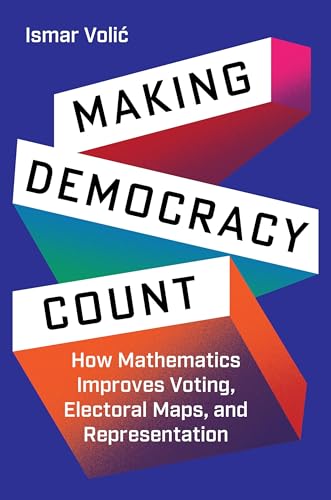
Making democracy count: how mathematics improves voting, electoral maps, and representation
Publication details: Princeton: Princeton University Press, 2024.Description: x, 392p.: hbk.: 25 cmISBN:- 9780691248806
- 324.60973 VOL
| Item type | Current library | Collection | Call number | Copy number | Status | Barcode | |
|---|---|---|---|---|---|---|---|
 Books
Books
|
IIT Gandhinagar | General | 324.60973 VOL (Browse shelf(Opens below)) | 1 | Available | 036124 |
Includes Acknowledgement, Glossary, Notes and Index.
What’s the best way to determine what most voters want when multiple candidates are running? What’s the fairest way to allocate legislative seats to different constituencies? What’s the least distorted way to draw voting districts? Not the way we do things now. Democracy is mathematical to its very foundations. Yet most of the methods in use are a historical grab bag of the shortsighted, the cynical, the innumerate, and the outright discriminatory. Making Democracy Count sheds new light on our electoral systems, revealing how a deeper understanding of their mathematics is the key to creating civic infrastructure that works for everyone.
In this timely guide, Ismar Volić empowers us to use mathematical thinking as an objective, nonpartisan framework that rises above the noise and rancor of today’s divided public square. Examining our representative democracy using powerful clarifying concepts, Volić shows why our current voting system stifles political diversity, why the size of the House of Representatives contributes to its paralysis, why gerrymandering is a sinister instrument that entrenches partisanship and disenfranchisement, why the Electoral College must be rethought, and what can work better and why. Volić also discusses the legal and constitutional practicalities involved and proposes a road map for repairing the mathematical structures that undergird representative government.
Making Democracy Count gives us the concrete knowledge and the confidence to advocate for a more just, equitable, and inclusive democracy.
https://press.princeton.edu/books/hardcover/9780691248806/making-democracy-count?srsltid=AfmBOooVZx0blYHHx7mt9aVty_MXcuvLe6-YBMCyV7S_unWRdpqgfRZ3
There are no comments on this title.


