
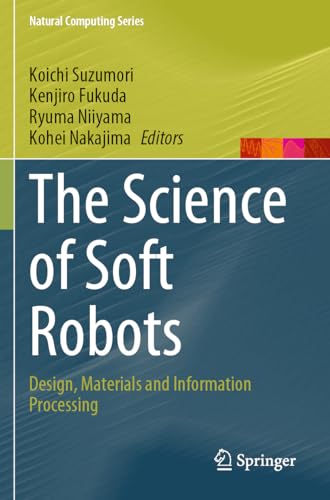
Science of soft robots: design, materials and information processing
Series: Natural Computing SeriesPublication details: Singapore: Springer, 2023.Description: xvi, 406p.: col. ill.; pbk.: 23cmISBN:- 9789811951763
- 006.3 SUZ
| Item type | Current library | Collection | Call number | Copy number | Status | Barcode | |
|---|---|---|---|---|---|---|---|
 Books
Books
|
IIT Gandhinagar | General | 006.3 SUZ (Browse shelf(Opens below)) | 1 | Available | 034728 |
Includes Reference and Index
The goal of this textbook is to equip readers with as structured knowledge of soft robotics as possible. Seeking to overcome the limitations of conventional robots by making them more flexible, gentle and adaptable, soft robotics has become one of the most active fields over the last decade. Soft robotics is also highly interdisciplinary, bringing together robotics, computer science, material science, biology, etc.
After the introduction, the content is divided into three parts: Design of Soft Robots; Soft Materials; and Autonomous Soft Robots. Part I addresses soft mechanisms, biological mechanisms, and soft manipulation & locomotion. In Part II, the basics of polymer, biological materials, flexible & stretchable sensors, and soft actuators are discussed from a materials science standpoint. In turn, Part III focuses on modeling & control of continuum bodies, material intelligence, and information processing using soft body dynamics. In addition, the latest research resultsand cutting-edge research are highlighted throughout the book.
Written by a team of researchers from highly diverse fields, the work offers a valuable textbook or technical guide for all students, engineers and researchers who are interested in soft robotics.
https://link.springer.com/book/10.1007/978-981-19-5174-9
There are no comments on this title.


