
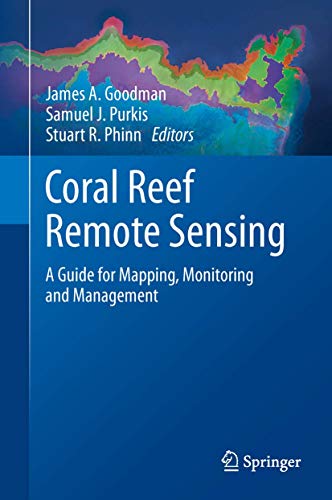
Coral reef remote sensing: a guide for mapping, monitoring and management
Publication details: Dordrecht: Springer, 2013.Description: xxv, 436p.: col. ill.; maps; hbk.: 24 cmISBN:- 9789048192915
- 621.3678 GOO
| Item type | Current library | Collection | Call number | Copy number | Status | Barcode | |
|---|---|---|---|---|---|---|---|
 Books
Books
|
IIT Gandhinagar | General | 621.3678 GOO (Browse shelf(Opens below)) | 1 | Available | 035140 |
Includes Bibliographical References, and Index
Remote sensing stands as the defining technology in our ability to monitor coral reefs, as well as their biophysical properties and associated processes, at regional to global scales. With overwhelming evidence that much of Earth’s reefs are in decline, our need for large-scale, repeatable assessments of reefs has never been so great. Fortunately, the last two decades have seen a rapid expansion in the ability for remote sensing to map and monitor the coral reef ecosystem, its overlying water column, and surrounding environment.
Remote sensing is now a fundamental tool for the mapping, monitoring and management of coral reef ecosystems. Remote sensing offers repeatable, quantitative assessments of habitat and environmental characteristics over spatially extensive areas. As the multi-disciplinary field of coral reef remote sensing continues to mature, results demonstrate that the techniques and capabilities continue to improve. New developments allow reef assessments and mapping to be performed with higher accuracy, across greater spatial areas, and with greater temporal frequency. The increased level of information that remote sensing now makes available also allows more complex scientific questions to be addressed.
https://link.springer.com/book/10.1007/978-90-481-9292-2
There are no comments on this title.


