
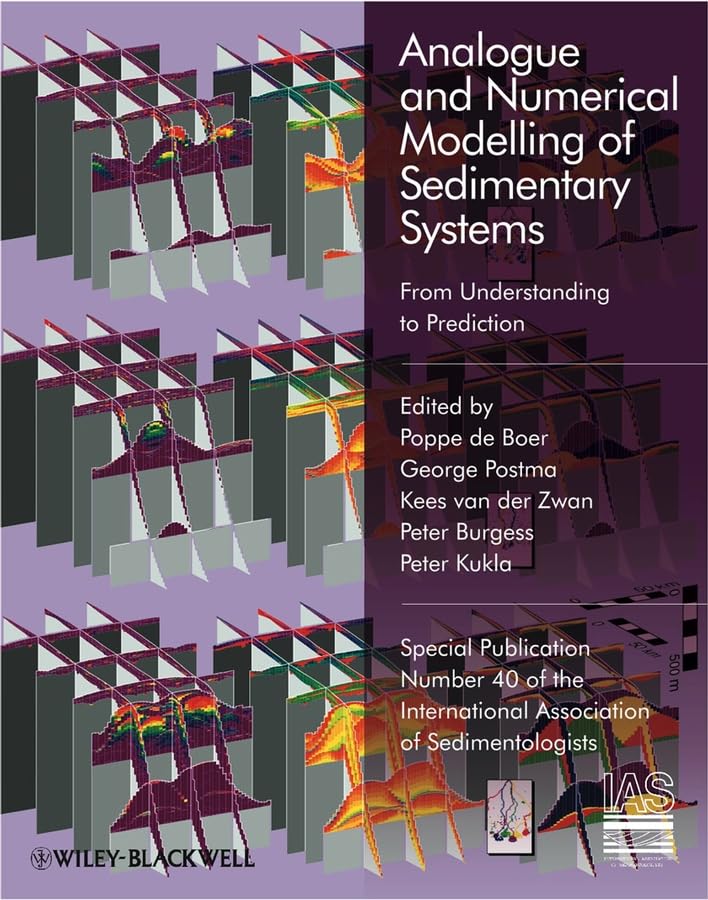
Analogue and numerical modelling of sedimentary systems: from understanding to prediction
Series: International Association Of Sedimentologists Series No. 40Publication details: Oxford: Wiley-Blackwell, 2008.Description: viii, 316p.; ill.; maps; hbk.: 29 cmISBN:- 9781405189309
- 552.5 BOE
| Item type | Current library | Collection | Call number | Copy number | Status | Barcode | |
|---|---|---|---|---|---|---|---|
 Books
Books
|
IIT Gandhinagar | General | 552.5 BOE (Browse shelf(Opens below)) | 1 | Available | 035011 |
Includes index
Understanding basin-fill evolution and the origin of stratal architectures has traditionally been based on studies of outcrops, well and seismic data, studies of and inferences on qualitative geological processes, and to a lesser extent based on quantitative observations of modern and ancient sedimentary environments. Insight gained on the basis of these studies can increasingly be tested and extended through the application of numerical and analogue forward models.
Present-day stratigraphic forward modelling follows two principle lines: 1) the deterministic process-based approach, ideally with resolution of the fundamental equations of fluid and sediment motion at all scales, and 2) the stochastic approach. The process-based approach leads to improved understanding of the dynamics (physics) of the system, increasing our predictive power of how systems evolve under various forcing conditions unless the system is highly non-linear and hence difficult or perhaps even impossible to predict. The stochastic approach is more direct, relatively simple, and useful for study of more complicated or less-well understood systems. Process-based models, more than stochastic ones, are directly limited by the diversity of temporal and spatial scales and the very incomplete knowledge of how processes operate and interact on the various scales.
The papers included in this book demonstrate how cross-fertilization between traditional field studies and analogue and numerical forward modelling expands our understanding of Earth-surface systems.
https://www.wiley.com/en-us/Analogue+and+Numerical+Modelling+of+Sedimentary+Systems%3A+From+Understanding+to+Prediction-p-9781405189309
There are no comments on this title.


