
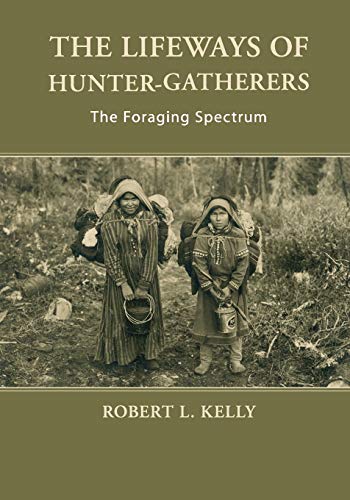
Lifeways of hunter-gatherers: the foraging spectrum
Publication details: Cambridge: Cambridge University Press, 2013.Edition: 2nd edDescription: xix, 362p.: ill., maps; pbk.: 25 cmISBN:- 9781107607613
- 306.364 KEL
| Item type | Current library | Collection | Call number | Copy number | Status | Barcode | |
|---|---|---|---|---|---|---|---|
 Books
Books
|
IIT Gandhinagar | General | 306.364 KEL (Browse shelf(Opens below)) | 1 | Available | 036687 |
Browsing IIT Gandhinagar shelves,Collection: General Close shelf browser (Hides shelf browser)


Includes Bibliographical References and Index
In this book, Robert L. Kelly challenges the preconceptions that hunter-gatherers were Paleolithic relics living in a raw state of nature, instead crafting a position that emphasizes their diversity, and downplays attempts to model the original foraging lifeway or to use foragers to depict human nature stripped to its core. Kelly reviews the anthropological literature for variation among living foragers in terms of diet, mobility, sharing, land tenure, technology, exchange, male-female relations, division of labor, marriage, descent and political organization. Using the paradigm of human behavioral ecology, he analyzes the diversity in these areas and seeks to explain rather than explain away variability, and argues for an approach to prehistory that uses archaeological data to test theory rather than one that uses ethnographic analogy to reconstruct the past. https://www.cambridge.org/in/universitypress/subjects/archaeology/prehistory/lifeways-hunter-gatherers-foraging-spectrum?format=HB&isbn=9781107024878
There are no comments on this title.


