
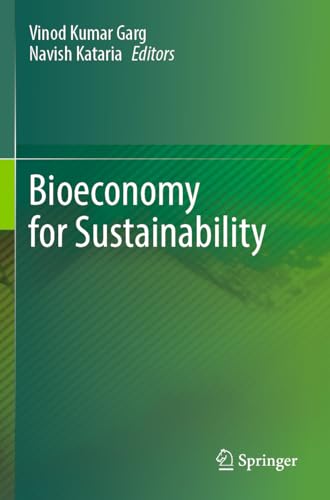
Bioeconomy for sustainability
Publication details: Singapore: Springer, 2024.Description: xvi, 408p.: col. ill.; pbk.: 24 cmISBN:- 9789819718399
- 338.476606 GAR
| Item type | Current library | Collection | Call number | Copy number | Status | Barcode | |
|---|---|---|---|---|---|---|---|
 Books
Books
|
IIT Gandhinagar | General | 338.476606 GAR (Browse shelf(Opens below)) | 1 | Available | 036309 |
Browsing IIT Gandhinagar shelves,Collection: General Close shelf browser (Hides shelf browser)

|

|

|

|

|

|

|
||
| 338.470053760954 UPA Reengineering India: work, capital, and class in an offshore economy | 338.47095491 HAQ Reimagining Pakistan: transforming a dysfunctional nuclear state | 338.473550095694 LOE Palestine laboratory: how Israel exports the technology of occupation around the world | 338.476606 GAR Bioeconomy for sustainability | 338.476649029 SEE Humans, animals, and the craft of slaughter in archaeo-historic societies | 338.47665730954 MEH Next stop: natural gas and India's journey to a clean energy future | 338.476691954 STR Steel town adivasis: industry and inequality in Eastern India |
Includes References.
This edited volume covers the key role of bioeconomy for next-generation industrial production to achieve Sustainable Development Goals. It addresses the key environmental challenges due to biowaste generation and their application in boosting the economy through the conversion of biowaste into valuable products for sustainable growth and future needs. This book also describes the potential future research scope and possibilities in bioeconomy towards sustainable industrial ecology and circular economy.
In recent years, competition has increased for determinate resources. There is an urgent need to look for sustainable, non-polluting alternate sources to meet the demands of an ever-increasing population. Sustainable processes and production while using biological material can produce food, fodder, agricultural inputs, fuel etc. with lesser inputs and reduced emission of pollutants. Agricultural waste and food waste are another concern which demands immediate interventions. The Bioeconomy can be a possible way to address these challenges. It includes sustainable production of food, fodder, fiber, fuel, agricultural inputs, and other goods while using renewable resources or different types of waste. This is beneficial to resolve diverse environmental problems such as future bioenergy production technology, societal transformations, pollution management, industrial circular economy, agricultural practices and food securities, climate management etc. Bioeconomy helps to move from a linear economy to a circular economy.
This book is a valuable source for researchers, teachers, and undergraduate and graduate students of environmental science, environmental economics, agriculture science, biotechnology, ecology, and soil science. It also serves as additional reading material for professionals, scientists, stakeholders of government and non-government organizations, industrialists, and policymakers of the relevant fields.
https://link.springer.com/book/10.1007/978-981-97-1837-5
There are no comments on this title.


