
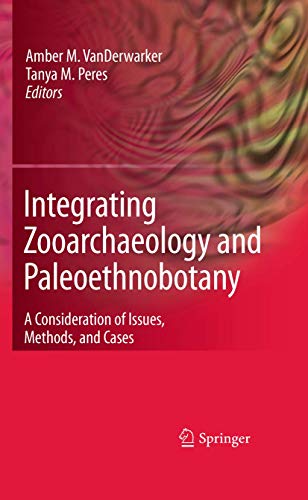
Integrating zooarchaeology and Paleoethnobotany: a consideration of issues, methods, and cases
Publication details: New York: Springer, 2010.Description: x, 335p.: maps; pbk.: 23 cmISBN:- 9781489984753
- 930.1 VAN
| Item type | Current library | Collection | Call number | Copy number | Status | Barcode | |
|---|---|---|---|---|---|---|---|
 Books
Books
|
IIT Gandhinagar | General | 930.1 VAN (Browse shelf(Opens below)) | 1 | Available | 035311 |
Browsing IIT Gandhinagar shelves,Collection: General Close shelf browser (Hides shelf browser)


Includes Appendix & Index
In recent years, scholars have emphasized the need for more holistic subsistence analyses, and collaborative publications towards this endeavor have become more numerous in the literature. However, there are relatively few attempts to qualitatively integrate zooarchaeological (animal) and paleoethnobotanical (plant) data, and even fewer attempts to quantitatively integrate these two types of subsistence evidence. Given the vastly different methods used in recovering and quantifying these data, not to mention their different preservational histories, it is no wonder that so few have undertaken this problem.
Integrating Zooarchaeology and Paleoethnobotany takes the lead in tackling this important issue by addressing the methodological limitations of data integration, proposing new methods and innovative ways of using established methods, and highlighting case studies that successfully employ these methods to shed new light on ancient foodways. The volume challenges the perception that plant and animal foodways are distinct and contends that the separation of the analysis of archaeological plant and animal remains sets up a false dichotomy between these portions of the diet. In advocating qualitative and quantitative data integration, the volume establishes a clear set of methods for (1) determining the suitability of data integration in any particular case, and (2) carrying out an integrated qualitative or quantitative approach.
https://link.springer.com/book/10.1007/978-1-4419-0935-0
There are no comments on this title.


