
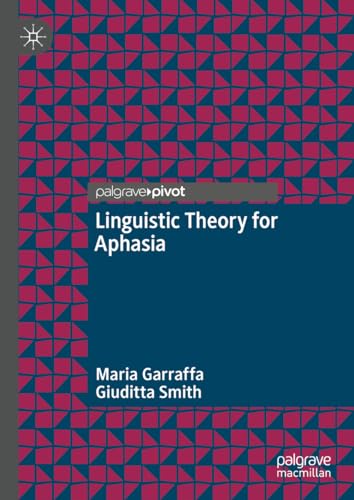
Linguistic theory for Aphasia
Publication details: Cham, Switzerland: Palgrave Macmillan, 2024.Description: xiii, 100p.: hbk.: 20 cmISBN:- 9783031771330
- 616.8552 GAR
| Item type | Current library | Collection | Call number | Copy number | Status | Barcode | |
|---|---|---|---|---|---|---|---|
 Books
Books
|
IIT Gandhinagar | General | 616.8552 GAR (Browse shelf(Opens below)) | 1 | Available | 035167 |
Includes Index
This book presents a cutting-edge overview of the language models of in phonology, morphology, syntax, and pragmatics, proposed to underlie language phenotypes across aphasic syndromes, as well as the potential applications of linguistic theory to advance therapeutic treatment -and research- in aphasiology. It draws together examples from a range of aphasic syndromes, providing valuable insights into the way language-specific properties may affect the manifestation of language deficits across aphasia. The authors discuss experimental evidence of deficits across language domains, which is crucial to those who study language abilities in aphasia. It concludes by examining how linguistic theory might contribute to patient classification in aphasia and to future directions for research in experimental linguistics and aphasiology. This book will appeal to students and scholars of neuropsychology, psycholinguistics, linguistics, and speech and language therapy.
https://link.springer.com/book/10.1007/978-3-031-77134-7
There are no comments on this title.


