
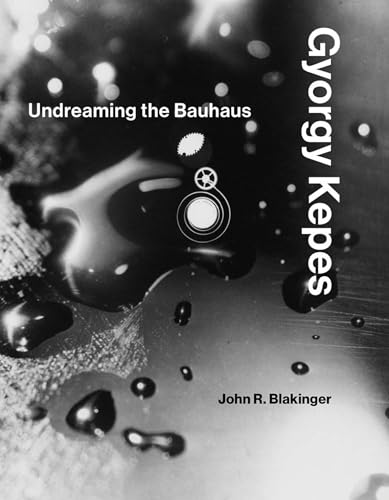
Gyorgy Kepes: undreaming the Bauhaus
Publication details: Cambridge, Massachusetts: MIT Press, 2019Description: xvi, 486p.: col. ill.; hbk: 24 cmISBN:- 9780262039864
- 700.105 BLA
| Item type | Current library | Collection | Call number | Copy number | Status | Barcode | |
|---|---|---|---|---|---|---|---|
 Books
Books
|
IIT Gandhinagar | General | 700.105 BLA (Browse shelf(Opens below)) | 1 | Available | 036084 |
Browsing IIT Gandhinagar shelves,Collection: General Close shelf browser (Hides shelf browser)

|

|

|

|

|

|

|
||
| 700.103 PHE Unmarked: the politics of performance | 700.1030994 BOU Field of cultural production | 700.103541 SIN Centrepiece: new writing and art from Northeast India | 700.105 BLA Gyorgy Kepes: undreaming the Bauhaus | 700.19 STA Feeling beauty: neuroscience of aesthetic experience | 700.19 WEI Interpreting visual art: a survey of cognitive research about pictures | 700.954 FRI New light on Hampi : recent research at Vijayanagara |
Includes Notes and Index
How Gyorgy Kepes, the last disciple of Bauhaus modernism, became the single most significant artist within a network of scientific experts and elites.
Gyorgy Kepes (1906–2001) was the last disciple of Bauhaus modernism, an acolyte of László Moholy-Nagy and a self-styled revolutionary artist. But by midcentury, transplanted to America, Kepes found he was trapped in the military-industrial-aesthetic complex. In this first book-length study of Kepes, John Blakinger argues that Kepes, by opening the research laboratory to the arts, established a new paradigm for creative practice: the artist as technocrat. First at Chicago's New Bauhaus and then for many years at MIT, Kepes pioneered interdisciplinary collaboration between the arts and sciences—what he termed “interthinking” and “interseeing.” Kepes and his colleagues—ranging from metallurgists to mathematicians—became part of an important but little-explored constellation: the Cold War avant-garde.
Blakinger traces Kepes's career in the United States through a series of episodes: Kepes's work with the military on camouflage techniques; his development of a visual design pedagogy, as seen in the exhibition The New Landscape and his book The New Landscape in Art and Science; his encyclopedic Vision + Value series; his unpublished magnum opus, the Light Book; the Center for Advanced Visual Studies (CAVS), an art-science research institute established by Kepes at MIT in 1967; and the Center's proposals for massive environmental installations that would animate the urban landscape. CAVS was entangled in the antiwar politics of the late 1960s, as many students and faculty protested MIT's partnerships with defense contractors—some of whom had ties to the Center. In attempting to “undream” the Bauhaus into existence in the postwar world, Kepes faced profound resistance.
Generously illustrated, drawing on the vast archive of Kepes's papers at Stanford and MIT's CAVS Special Collection, this book supplies a missing chapter in our understanding of midcentury modern and Cold War visual culture.
https://mitpress.mit.edu/9780262039864/gyorgy-kepes/
There are no comments on this title.


