
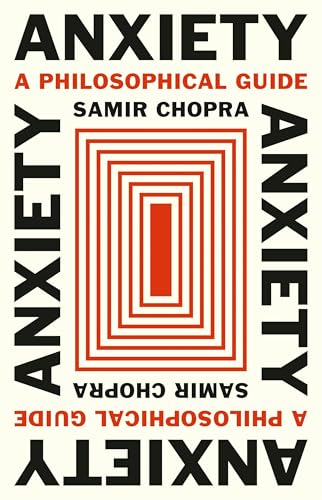
Anxiety: a philosophical guide
Publication details: Princeton: Princeton University Press, 2024.Description: xi, 185p.: hbk.: 23cmISBN:- 9780691210674
- 152.46 CHO
| Item type | Current library | Collection | Call number | Copy number | Status | Barcode | |
|---|---|---|---|---|---|---|---|
 Books
Books
|
IIT Gandhinagar | General | 152.46 CHO (Browse shelf(Opens below)) | ONE | Available | 034622 |
Browsing IIT Gandhinagar shelves,Collection: General Close shelf browser (Hides shelf browser)

|

|

|

|

|

|

|
||
| 152.42 LOM Happiness | 152.43 AAK Humour, seriously: why humour is a secret weapon in business and life (and how anyone can harness it. even you.) | 152.44 BUR You are your best thing : vulnerability, shame resilience, and the black experience | 152.46 CHO Anxiety: a philosophical guide | 152.46 GUP Tara goes Aahhhhh | 152.46 HAR Managing your anxiety | 152.46 THE Anxiety: meditations on the anxious mind |
Includes notes, bibliography, and index.
Today, anxiety is usually thought of as a pathology, the most diagnosed and medicated of all psychological disorders. But anxiety isn’t always or only a medical condition. Indeed, many philosophers argue that anxiety is a normal, even essential, part of being human, and that coming to terms with this fact is potentially transformative, allowing us to live more meaningful lives by giving us a richer understanding of ourselves. In Anxiety, Samir Chopra explores valuable insights about anxiety offered by ancient and modern philosophies—Buddhism, existentialism, psychoanalysis, and critical theory. Blending memoir and philosophy, he also tells how serious anxiety has affected his own life—and how philosophy has helped him cope with it.
Chopra shows that many philosophers—including the Buddha, Kierkegaard, Nietzsche, Freud, and Heidegger—have viewed anxiety as an inevitable human response to existence: to be is to be anxious. Drawing on Karl Marx and Herbert Marcuse, Chopra examines how poverty and other material conditions can make anxiety worse, but he emphasizes that not even the rich can escape it. Nor can the medicated. Inseparable from the human condition, anxiety is indispensable for grasping it. Philosophy may not be able to cure anxiety but, by leading us to greater self-knowledge and self-acceptance, it may be able to make us less anxious about being anxious.
Personal, poignant, and hopeful, Anxiety is a book for anyone who is curious about rethinking anxiety and learning why it might be a source not only of suffering but of insight.
https://press.princeton.edu/books/hardcover/9780691210674/anxiety
There are no comments on this title.


