
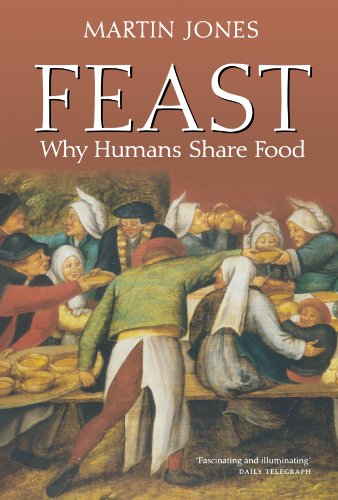
Feast: why humans share food
Publication details: Oxford: Oxford University Press, 2008.Description: xiv, 364p.: ill. maps; pbk.: 23 cmISBN:- 9780199533527
- 394.1 JON
| Item type | Current library | Collection | Call number | Copy number | Status | Barcode | |
|---|---|---|---|---|---|---|---|
 Books
Books
|
IIT Gandhinagar | General | 394.1 JON (Browse shelf(Opens below)) | 1 | Available | 035264 |
Browsing IIT Gandhinagar shelves,Collection: General Close shelf browser (Hides shelf browser)

|

|

|

|

|

|

|
||
| 393.9309510905 KIP Funeral of Mr. Wang: life, death, and ghosts in urbanizing China | 394.12 PHI Media and food industries: the new politics of food | 394 HEI Theories of the gift in South Asia: Hindu, Buddhist, and Jain reflections on dana | 394.1 JON Feast: why humans share food | 394.12 COU Food and culture : a reader | 394.12 DAV Consuming geographies: we are where we eat | 394.12 JOH Foodies: democracy and distinction in the gourmet foodscape |
Includes Bibliographical References, Index and Notes
Is sharing food such an everyday, unremarkable occurrence?
In fact, the human tendency to sit together peacefully over food is actually rather an extraordinary phenomenon, and one which many species find impossible. It is also a pheonomenon with far-reaching consequences for the global environment and human social evolution.
So how did this strange and powerful behaviour come about? In Feast, Martin Jones uses the latest archaeological methods to illuminate how humans came to share food in the first place and how the human meal has developed since then.
From the earliest evidence of human consumption around half a million years ago to the era of the TV dinner and the drive-through diner, this fascinating account unfolds the history of the human meal and its huge impact both on human society and the ecology of the planet.
https://global.oup.com/academic/product/feast-9780199209019?cc=in&lang=en&#
There are no comments on this title.


