
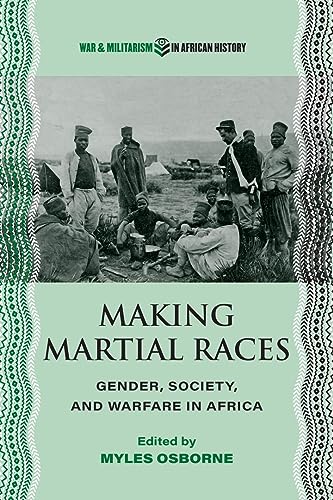
Making martial races: gender, society, and warfare in Africa
Series: War and Militarism in African HistoryPublication details: Athens, Ohio: Ohio University Press, 2024.Description: xii, 337p.: ill., maps; pbk.: 23 cmISBN:- 9780821426180
- 355.352096 OSB
| Item type | Current library | Collection | Call number | Copy number | Status | Barcode | |
|---|---|---|---|---|---|---|---|
 Books
Books
|
IIT Gandhinagar | General | 355.352096 OSB (Browse shelf(Opens below)) | 1 | Available | 034460 |
Browsing IIT Gandhinagar shelves,Collection: General Close shelf browser (Hides shelf browser)

|

|

|

|

|

|

|
||
| 355.033073 SAN National security challenges: young scholars' perspective | 355.30917124109034 STR Martial races: the military, race and masculinity in British imperial culture, 1857-1914 | 355.331092254 SIN Leadership in the Indian army: biographies of twelve soldiers | 355.352096 OSB Making martial races: gender, society, and warfare in Africa | 355.4 PAN Wings of valour : true stories of the Indian Air Force's daring operations | 355.424 TRA Elephants and kings: an environmental history | 355.82511909 WOL Nuclear weapons |
Includes Index.
European colonizers in Africa required the service of local soldiers and military auxiliaries to uphold their power. These African men were initially engaged by the expeditions of European surveyors and explorers during the late nineteenth century, then quickly pressed into service in the notorious campaigns of pacification. Two world wars further expanded both the numbers of African soldiers in European employ and the roles they played; many of these men would continue their jobs into the era of decolonization in the 1960s and 1970s.
Colonial administrators and military planners often chose their recruits based on the notion of “martial race”—a label that denoted peoples supposedly possessing an inborn aptitude for warfare and fighting. But the notion always obscured more than it revealed: few Europeans could agree on which “races”—or ethnic groups—were “martial,” and in any case, the identities of those groups changed continuously. Nevertheless, this belief remained a fundamental, guiding principle of the European presence in colonial Africa.
The concept of “martial race” remains an awkward and ill-fitting Eurocentric category until African contributions, perspectives, and agencies are considered. “Martial race” was never a label neatly affixed by European administrators; rather, African peoples both contested its terms and shaped its contours. This book therefore takes as its starting point the idea of martial race and recasts it as a zone in which African men and women negotiated with their European counterparts, as well as with one another.
https://www.ohioswallow.com/9780821426180/making-martial-races/
There are no comments on this title.


