
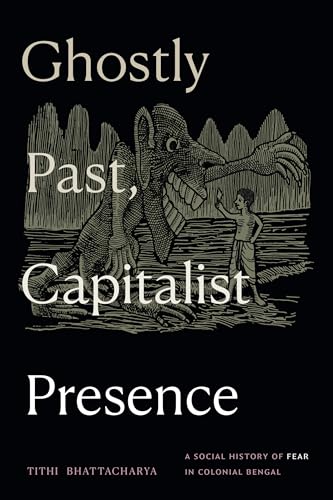
Ghostly past, capitalist presence: a social history of fear in colonial Bengal
Publication details: Durham: Duke University Press, 2024.Description: xi, 214p.: col., ill.; pbk.: 23cmISBN:- 9781478030713
- 954.1403 BHA
| Item type | Current library | Collection | Call number | Copy number | Status | Barcode | |
|---|---|---|---|---|---|---|---|
 Books
Books
|
IIT Gandhinagar | General | 954.1403 BHA (Browse shelf(Opens below)) | 1 | Available | 034649 |
Browsing IIT Gandhinagar shelves,Collection: General Close shelf browser (Hides shelf browser)


Includes notes, bibliography, and index.
In Ghostly Past, Capitalist Presence, Tithi Bhattacharya maps the role that Bengali ghosts and ghost stories played in constituting the modern Indian nation, and the religious ideas seeded therein, as it emerged in dialogue with European science. Bhattacharya introduces readers to the multifarious habits and personalities of Bengal’s traditional ghosts and investigates and mourns their eventual extermination. For Bhattacharya, British colonization marked a transition from the older, multifaith folk world of traditional ghosts to newer and more frightening specters. These "modern" Bengali ghosts, borne out of a new rationality, were homogeneous specters amenable to "scientific" speculation and invoked at séance sessions in elite drawing rooms. Reading literature alongside the colonial archive, Bhattacharya uncovers a new reordering of science and faith from the middle of the nineteenth century. She argues that these shifts cemented the authority of a rising upper-caste colonial elite who expelled the older ghosts in order to recast Hinduism as the conscience of the Indian nation. In so doing, Bhattacharya reveals how capitalism necessarily reshaped Bengal as part of the global colonial project.
https://www.dukeupress.edu/ghostly-past-capitalist-presence
There are no comments on this title.


