
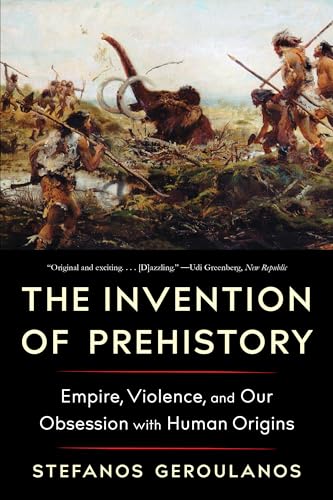
Invention of prehistory: empire, violence, and our obsession with human origins
Publication details: New York: Liveright Publishing, 2025.Description: 498p.: ill., maps; pbk.: 22 cmISBN:- 9781324096122
- 569.9 GER
| Item type | Current library | Collection | Call number | Copy number | Status | Barcode | |
|---|---|---|---|---|---|---|---|
 Books
Books
|
IIT Gandhinagar | General | 569.9 GER (Browse shelf(Opens below)) | 1 | Available | 036029 |
Includes Acknowledgements, Notes, Image Credits and Index
Books about the origins of humanity dominate bestseller lists, while national newspapers present breathless accounts of new archaeological findings and speculate about what those findings tell us about our earliest ancestors. We are obsessed with prehistory—and, in this respect, our current era is no different from any other in the last three hundred years. In this coruscating work, acclaimed historian Stefanos Geroulanos demonstrates how claims about the earliest humans not only shaped Western intellectual culture, but gave rise to our modern world.
The very idea that there was a human past before recorded history only emerged with the Enlightenment, when European thinkers began to reject faith-based notions of humanity and history in favor of supposedly more empirical ideas about the world. From the “state of nature” and Romantic notions of virtuous German barbarians to theories about Neanderthals, killer apes, and a matriarchal paradise where women ruled, Geroulanos captures the sheer variety and strangeness of the ideas that animated many of the major thinkers of the eighteenth and nineteenth centuries, including Jean-Jacques Rousseau, Charles Darwin, and Karl Marx. Yet as Geroulanos shows, such ideas became, for the most part, the ideological foundations of repressive regimes and globe-spanning empires. Deeming other peoples “savages” allowed for guilt-free violence against them; notions of “killer apes” who were our evolutionary predecessors made war seem natural. The emergence of modern science only accelerated the West’s imperialism. The Nazi obsession with race was rooted in archaeological claims about prehistoric IndoGermans; the idea that colonialized peoples could be “bombed back to the Stone Age” was made possible by the technology of flight and the anthropological idea that civilization advanced in stages.
As Geroulanos argues, accounts of prehistory tell us more about the moment when they are proposed than about the deep past—and if we hope to start improving our future, we would be better off setting aside the search for how it all started. A necessary, timely, indelible account of how the quest for understanding the origins of humanity became the handmaiden of war and empire, The Invention of Prehistory will forever change how we think about the deep past.
https://wwnorton.com/books/9781324096122
There are no comments on this title.


