
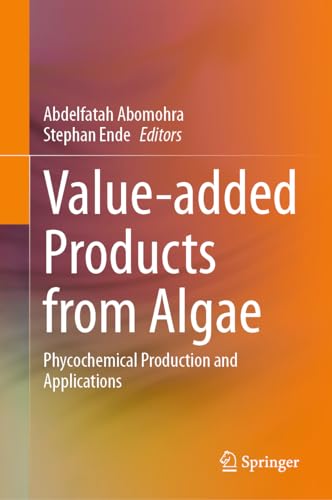
Value-added products from Algae: phycochemical production and applications
Publication details: Cham: Springer, 2024.Description: xiv, 612 pages col. ill.; hbk.: 22cmISBN:- 9783031420252
- 660.6 ABO
| Item type | Current library | Collection | Call number | Copy number | Status | Barcode | |
|---|---|---|---|---|---|---|---|
 Books
Books
|
IIT Gandhinagar | General | 660.6 ABO (Browse shelf(Opens below)) | 1 | Available | 035741 |
This book provides a comprehensive overview of value-added products from algae, presenting the fundamentals of algal cultivation, metabolism, harvest, and cellular pathways of phycochemicals biosynthesis. It offers sufficient details for both experts and non-experts to grasp the recent progress in this field. The book also discusses new phycochemicals and advancements in technology development, from separation to scale-up commercialization.
Divided into 18 chapters, the book begins with an introduction to the value of algae as a renewable resource, followed by an authoritative overview of topics such as algae cultivation systems, harvesting techniques, phycochemical analysis, artificial intelligence in phytochemical recognition, and bioprocess engineering. Additional chapters cover various aspects of algal biotechnology, including biorefinery technology, biofuel-integrated routes, and the use of wastewater for algal growth. The book also explores high throughput screening methods for microalgae-based phycochemicals and examines the catalytic processes involved in algal bioprocessing. Cutting-edge topics such as omics approaches for algal applications, algal-based biopolymers, diatom nanostructured biosilica, and the potential of seaweeds in methane emission mitigation, are also explored. In this book, readers will discover the recent technological applications of algae in aquaculture and will find a case study on the functional food potential of Spirulina. Recognizing the importance of legislation and biosecurity in the field, the last chapter of the book addresses the regulatory frameworks and biosecurity measures necessary for the safe and sustainable development of algal biotechnology.
Given its breadth, the book is a valuable resource for scholars, researchers and professionals interested in algal biotechnology, sustainability, biomass conversion, and new algal products from any perspective.
https://link.springer.com/book/10.1007/978-3-031-42026-9
There are no comments on this title.


