
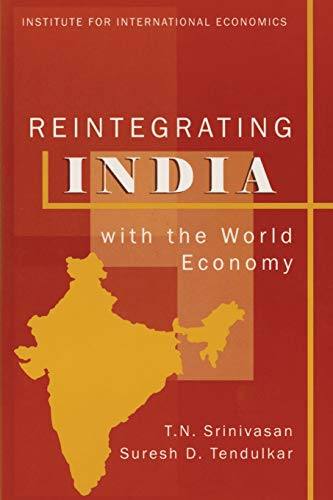
Reintegrating India with the world economy
Publication details: Institute for International Economics, 2003 Washington:Description: xiv, 167p. pb; 20 cmISBN:- 9780881322804
- 337.54 SRI
| Item type | Current library | Call number | Copy number | Status | Barcode | |
|---|---|---|---|---|---|---|
 Books
Books
|
IIT Gandhinagar | 337.54 SRI (Browse shelf(Opens below)) | 1 | Available | 028424 |
Annotation. After nearly five decades of insulation from world markets, state controls, and slow growth, India embarked in 1991 on a process of liberalization of controls and progressive integration with the global economy in an effort to put its economy on a path of rapid and sustained growth. Despite major changes in the government since then, the thrust of reforms has been maintained. According to the World Bank, only 19 out of 137 countries had more rapid growth than India's at over six percent per year in the 1990s.In this study, Professors Srinivasan and Tendulkar analyze the economics and politics of India's recent and growing integration with the world economy. They argue that this process has to be nurtured and accelerated if India is to eradicate its poverty and take its rightful place in the global economic system. The topics covered include historical roots and the political economy of India's late integration; domestic and external constraints on integration; external capital inflows including foreign direct investment; and India's emerging comparative advantage in the information technology industry and services, particularly computer software. The final chapter offers policy recommendations.
There are no comments on this title.


